Vocabulary is the single greatest predictor of academic success, lifetime earnings, and career advancement — and there is no platform that serves it continuously across a human life. Webtionary is the .com that fixes that.
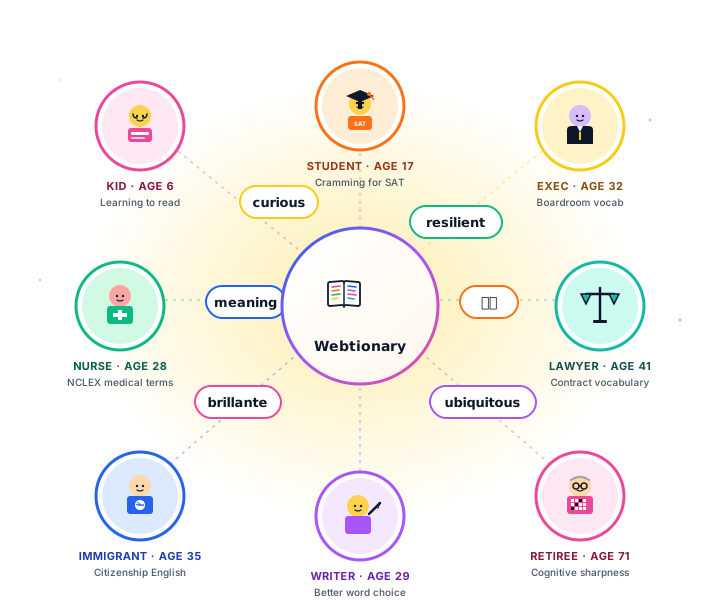
A 6-year-old learning to read. A 10th grader cramming for SAT. A college student writing applications. A new immigrant studying for citizenship. A nurse learning NCLEX terminology. A lawyer mastering contract language. A first-generation professional closing the vocabulary gap with Ivy League colleagues. A 71-year-old doing word puzzles to stay cognitively sharp.
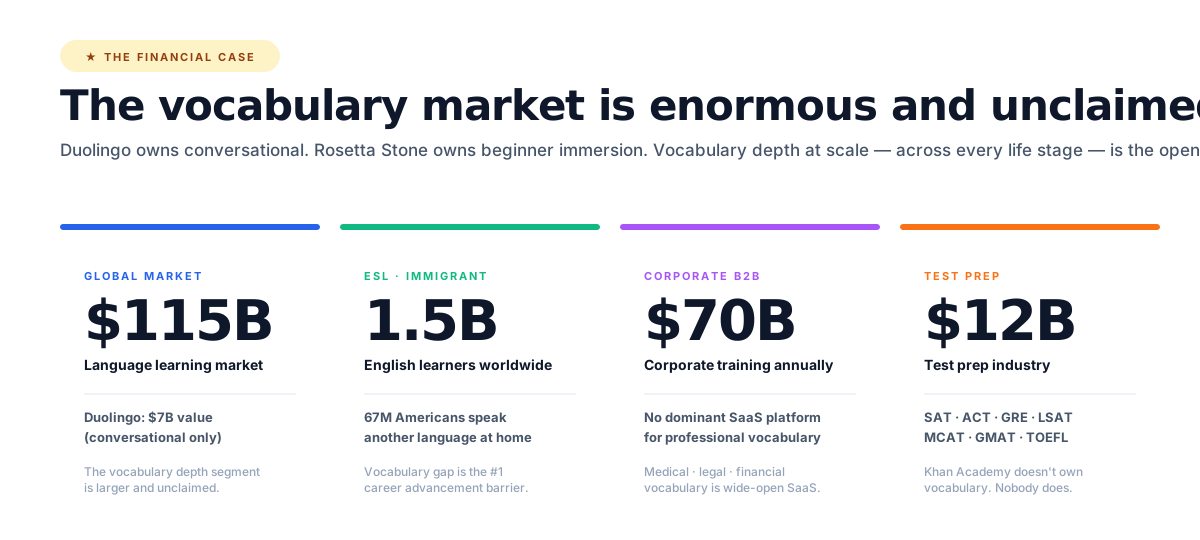
Every single one of these people is using Google, ChatGPT, random flashcard apps, or nothing. There is no continuous, personalized, domain-aware vocabulary companion. Duolingo is conversational and gamified but shallow. Vocabulary.com stops at K-12. Dictionary.com is a lookup tool. Rosetta Stone is for beginners. None of them are a lifelong vocabulary intelligence platform.
Everyone needs it. Nobody has it. That's the gap. That's the hook.
Every human's relationship with words evolves over a lifetime. The category that wins captures all of them under one umbrella brand. Here's who walks through the door.
Phonics, sight words, early literacy. Gamified vocabulary aligned to school curricula.
2,000+ high-frequency exam words. Adaptive mastery by deadline. Score impact predictions.
Domain-specific business words for finance, strategy, leadership. Sound credible in any room.
5,000+ medical vocabulary terms. Pharmacology, anatomy, procedures. Career-defining exam.
Legal terminology by practice area. Latin maxims, evidence rules, jurisdiction-specific terms.
Civics, daily life, professional English. Powered by Rosetta Stone bilingual infrastructure.
Synonyms, register, tone. The successor to Thesaurus.com — but personalized to your voice.
Word puzzles, daily challenges, etymology games. Vocabulary as cognitive maintenance.
Every word. Every learner. Every life stage.
webtionary.com · est. 1996
Generic LLMs answer one-shot questions. They have no memory of you, no model of your goals, no awareness of what you've already mastered or forgotten. Webtionary's AI is personalized, longitudinal, and domain-aware — three things ChatGPT, Gemini, and Claude fundamentally aren't built to be.
Tracks your retention curve word-by-word across years. Surfaces the right vocabulary at the right interval before forgetting hits. Vocabulary.com's existing engine, scaled across the entire portfolio.
Studying for NCLEX? It knows the medical vocabulary by section. Bar exam? Legal terminology by jurisdiction. SAT? The 2,000 highest-frequency exam words. The model is goal-aware, not just question-aware.
Powered by Rosetta Stone + SpanishDictionary infrastructure. A new immigrant studying citizenship vocabulary doesn't need a definition in English — they need the concept bridged from Spanish, Mandarin, Tagalog, or Arabic.
Surfaces what each student needs to drill before the next test. Generates personalized vocabulary lists. Explains why a word is hard for this learner. Built on Vocabulary.com's classroom data and IXL's 95-of-100-districts distribution.
Through 14 acquisitions, IXL has gathered the world's most complete vocabulary infrastructure — and it's all sitting siloed across legacy domains being eaten by AI. Webtionary is the brand that finally connects it.
This isn't a domain listing. It's a strategic memo for IXL's executive team — framed around their burning platform and the asset that fixes it.
Dictionary.com lost 37% of its traffic in 2025. Every reference brand in your portfolio has the same structural problem. We own webtionary.com — registered 1996 — and we believe it's the brand IXL uses to consolidate, rebrand, and rebuild this into something bigger than what AI is taking away.
We've outlined the strategic case at webtionary.com — including the financial opportunity, the consolidation play across your existing assets, and how the brand maps to a unified product line spanning K-8 vocabulary through enterprise.
Open to a 20-minute conversation. The category is moving fast, and the .com is rare.
Webtionary.com was registered in 1996 — when Yahoo was a directory and Amazon sold only books. Three decades of vintage. A name that fuses "web" (the universal modifier of modern knowledge) with the "-tionary" suffix (instantly suggesting authoritative reference, like dictionary, missionary, evolutionary).
The category for a lifelong personalized vocabulary platform didn't exist in 1996. It does now. And the .com that names it is sitting here, with no trademark conflicts and three decades of search-engine pedigree.
Serious inquiries welcome from IXL Learning, founders building in vocabulary or language learning, strategic acquirers, and brokers. The 1996 vintage and category-perfect fit make this a rare asset.